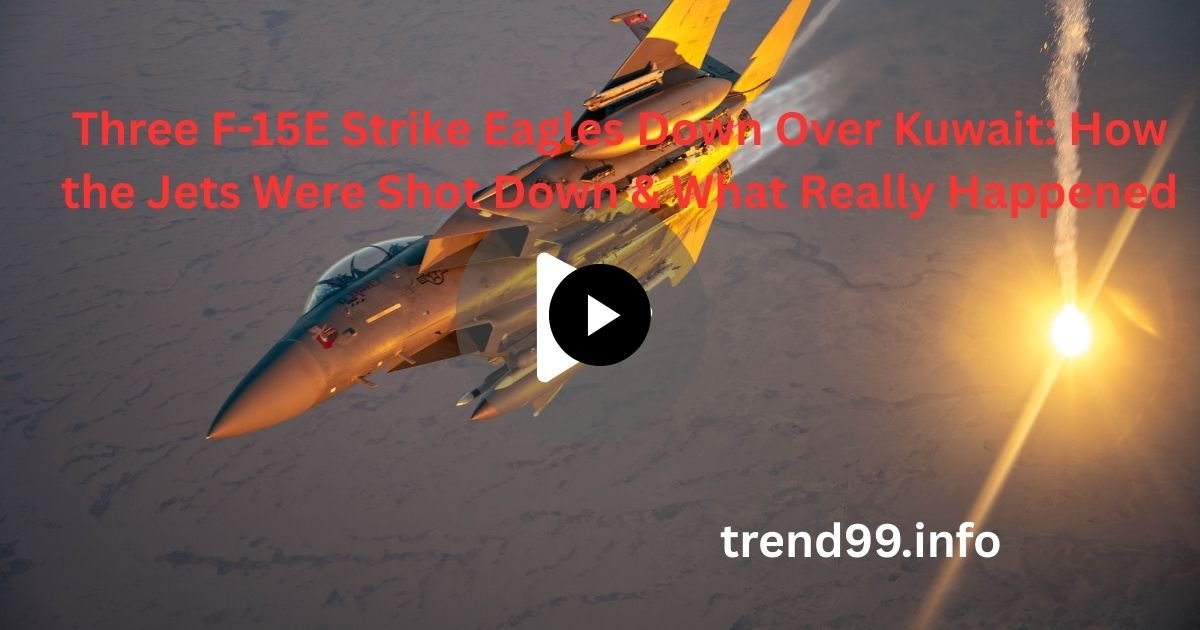
Imagine the shockwaves rippling through military circles when news broke that three advanced U.S. F-15E Strike Eagles were down over Kuwait in a single incident. This rare and tragic event, involving some of the most capable fighter jets in the American arsenal, unfolded amid escalating tensions in the Gulf region.
For a USA audience deeply invested in national security and military prowess, understanding how these F-15E jets were shot down in Kuwait raises critical questions about alliances, technology, and the fog of war.
In this comprehensive blog post, we’ll dive deep into the details of the three F-15E Strike Eagles down over Kuwait, exploring how the jets were shot down and what really happened. We’ll cover everything from the initial overview to expert analyses, incorporating variations like the Strike Eagles downed in Kuwait airspace and the implications for future operations. Drawing from official statements and expert insights, this article aims to provide a clear, factual breakdown tailored for readers concerned about U.S. military engagements abroad.
The incident occurred on March 1, 2026, at 11:03 p.m. ET, during Operation Epic Fury, a U.S.-led campaign responding to Iranian aggression. All six aircrew members—comprising pilots and weapons systems officers—ejected safely and were recovered in stable condition, a testament to the robustness of ejection systems in modern jets. However, the loss of these multimillion-dollar aircraft highlights vulnerabilities even in allied territories. As we unpack the story of the F-15E jets shot down over Kuwait, we’ll examine the sequence of events, the role of air defenses, and the broader strategic fallout, ensuring you get a full picture of this pivotal moment in recent military history
Incident Overview: Jets Downed Over Kuwait
The downing of three F-15E Strike Eagles over Kuwait sent alarm bells ringing across U.S. Central Command (CENTCOM) and beyond. On March 1, 2026, at approximately 11:03 p.m. ET (which corresponds to early morning hours in Kuwait), these jets were engaged in combat support operations when they were mistakenly targeted by Kuwaiti air defense systems. This apparent friendly fire incident resulted in all three aircraft being shot down, marking one of the most significant losses of U.S. fighter jets in recent years. The F-15E Strike Eagle, a twin-engine, all-weather multirole fighter developed by Boeing, is renowned for its air-to-air and air-to-ground capabilities, with a top speed exceeding Mach 2.5 and advanced avionics that make it a cornerstone of U.S. air power.
Initial reports from CENTCOM confirmed that the jets were flying in support of Operation Epic Fury, a response to Iranian attacks involving aircraft, ballistic missiles, and drones. Kuwait, a key U.S. ally in the region, acknowledged the mishap, expressing gratitude for joint efforts while an investigation was launched.
For the USA audience, this event underscores the risks American forces face even in friendly skies, with the pilots’ safe recovery providing a silver lining amid the wreckage. Eyewitness accounts and social media videos quickly surfaced, showing fiery explosions and ejections, amplifying public interest in how these Strike Eagles were downed over Kuwait.
Key facts about the incident include:
- Aircraft Involved: Three F-15E Strike Eagles from the U.S. Air Force.
- Crew Status: All six members (three pilots and three weapons systems officers) ejected safely and were in stable condition.
- Location: Over Kuwaiti airspace, possibly near the western edge of Al Jahra.
- Cause: Apparent friendly fire from Kuwaiti surface-to-air missiles.
- Context: Part of broader combat against Iranian threats.
This overview sets the stage for a deeper look into the timeline and mechanics of the F-15E jets shot down in Kuwait, revealing how a routine mission turned catastrophic.
2. Timeline of the Air Combat Event
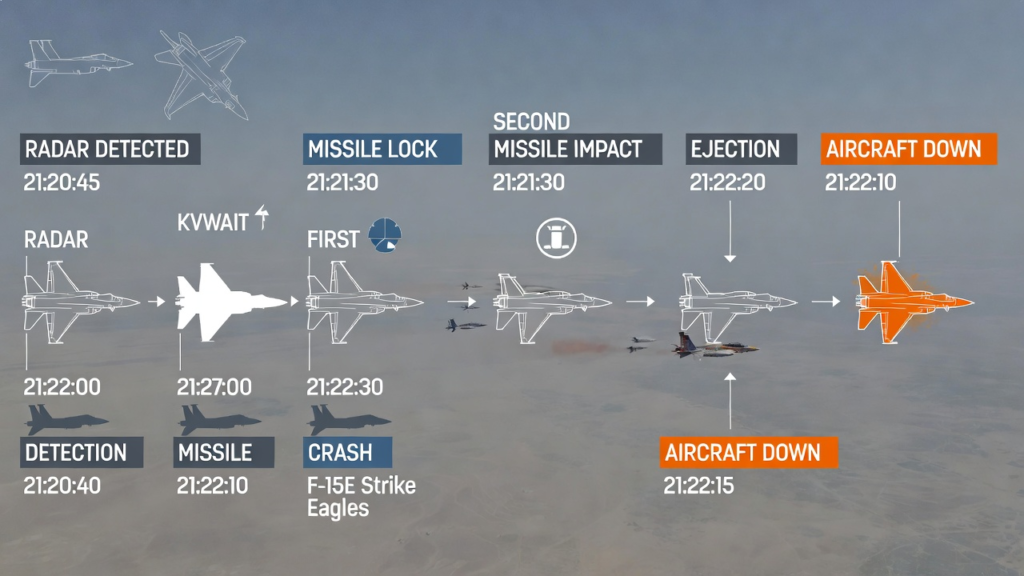
The air combat event leading to the three F-15E Strike Eagles down over Kuwait unfolded rapidly in a high-stakes environment. Starting from the jets’ takeoff from a base in the region likely Al Udeid Air Base in Qatar or Ali Al Salem Air Base in Kuwait—the mission escalated quickly due to incoming Iranian threats. At around 11:00 p.m. ET on March 1, 2026, radar detections picked up the U.S. jets as they entered active combat zones, but misidentification led to engagement just minutes later.
Here’s a detailed chronological breakdown based on official releases and emerging reports:
- 10:45 p.m. ET: The F-15Es launch and form up for patrol, monitoring Iranian drone and missile activity.
- 11:00 p.m. ET: Entry into Kuwaiti airspace amid reports of Iranian ballistic missile launches.
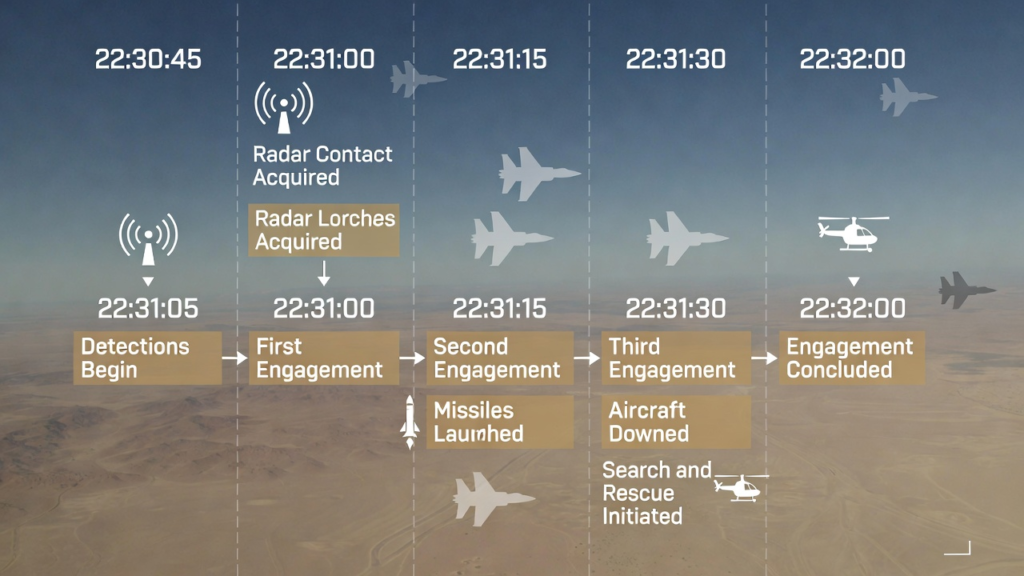
- 11:03 p.m. ET: Kuwaiti air defenses acquire targets; first missile lock and launch occurs, hitting the lead jet.
- 11:04 p.m. ET: Second and third jets attempt evasive maneuvers but are engaged in quick succession.
- 11:05 p.m. ET: All three aircraft down, with ejections confirmed via radio and visual sightings.
- 11:15 p.m. ET: Search and rescue operations initiated, with crews recovered by coalition forces.
This timeline highlights the compressed decision-making window in modern air combat, where seconds can mean the difference between success and disaster. Videos circulating online captured the dramatic moments, showing jets spiraling in flames, which fueled discussions on what really happened when the Strike Eagles were shot down over Kuwai
Three USAF F-15E Strike Eagles Shot Down By Friendly Fire (Updated)
3. Mission Operations Before the Crash
Before the crash of the three F-15E Strike Eagles down over Kuwait, the mission was a standard combat air patrol integrated into Operation Epic Fury. The jets, equipped with advanced radar like the AN/APG-82 AESA and precision munitions such as JDAMs and AIM-120 missiles, were tasked with intercepting Iranian drones and providing close air support to ground forces. Pilots underwent thorough briefings on threats, including potential electronic warfare from Iran, and coordinated with AWACS aircraft for real-time intel.
Weather conditions were clear, with minimal interference, but the high-threat environment meant flying at medium altitudes to balance speed and evasion. The formation—a typical delta setup—allowed for mutual support, but as they approached Kuwaiti borders, communication with allied defenses became crucial. This phase illustrates how even well-planned operations can veer off course, leading to the F-15E jets being shot down in Kuwait due to unforeseen coordination lapses.
4. Entry Into High-Risk Airspace
The entry of the three F-15E Strike Eagles into high-risk airspace over Kuwait was dictated by the dynamic nature of the conflict. As Iranian forces launched a barrage of missiles and drones, the jets pushed forward to engage, crossing into zones protected by layered air defenses. Rules of engagement emphasized positive identification, but in the heat of battle, this proved challenging. The aircraft’s low-observable coatings and jamming pods were active, yet they weren’t fully stealthy against ground-based radars.
This move exposed them to risks from both enemy and friendly systems, culminating in the tragic shootdown. Analysts note that such entries require seamless deconfliction, a process that apparently faltered here, contributing to how the jets were shot down over Kuwait.
5. Activation of Regional Air Defense Systems
Regional air defense systems in Kuwait sprang into action amid the Iranian assault, with radars lighting up to track multiple threats. Kuwait’s integrated network, featuring Patriot missiles and other SAMs, was on high alert, authorized to engage unidentified targets. Triggers included radar signatures matching hostile profiles, leading to rapid activation. However, in the multi-nation chaos, U.S. jets were misclassified, highlighting coordination gaps in allied operations during the incident where Strike Eagles were downed over Kuwait.
6. How the Fighter Jets Were Detected
Detection of the fighter jets relied on ground-based radars like those in the Patriot system, which scanned for high-speed inbounds. The F-15Es’ radar cross-section, while reduced, was picked up due to their speed and altitude. Infrared sensors may have contributed, especially if afterburners were engaged. Environmental factors, such as desert clutter, complicated matters, but human confirmation sealed the erroneous targeting, explaining part of how the three F-15E down over Kuwait occurred.
7. Missile Lock and Target Identification
Missile lock involved radar-guided SAMs achieving a stable track on the jets. Target identification faltered when IFF queries returned ambiguous results, possibly due to electronic interference. In split seconds, operators fired, mistaking the U.S. aircraft for Iranian intruders. This step underscores the critical role of identification systems in preventing such mishaps in the F-15E jets shot down over Kuwait.
8. Air Defense Response Against Aircraft
The air defense response was swift, involving missile launches and potential interceptor scrambles. Against agile targets like F-15Es, the systems proved effective due to surprise. Warnings via radio might have been attempted but overwhelmed by comms traffic, leading to direct engagement and the downing of the Strike Eagles over Kuwait.
9. Possible Friendly-Fire Scenario Explained
The friendly-fire scenario is the leading explanation, with Kuwaiti defenses mistaking the jets for threats amid Iranian attacks. Historical parallels, like the 2003 Patriot downing of a U.S. F/A-18, show how stress and system errors contribute. Poor visibility at night and radar confusion played roles, as investigations confirm in this case of three F-15E down over Kuwait.
10. Role of Surface-to-Air Missile Systems
Surface-to-air missile systems, likely MIM-104 Patriots operated by Kuwait, were central. These have a range of over 100 km and high accuracy against aircraft. Integrated with early warning radars, they engaged the jets effectively, despite U.S. countermeasures like chaff and flares. This role was pivotal in how the aircraft went down over Kuwait.
How the Aircraft Went Down
Delving into how the aircraft went down reveals a sequence of hits and losses that unfolded in minutes, turning a defensive mission into a survival scramble for the crews involved in the three F-15E Strike Eagles down over Kuwait.
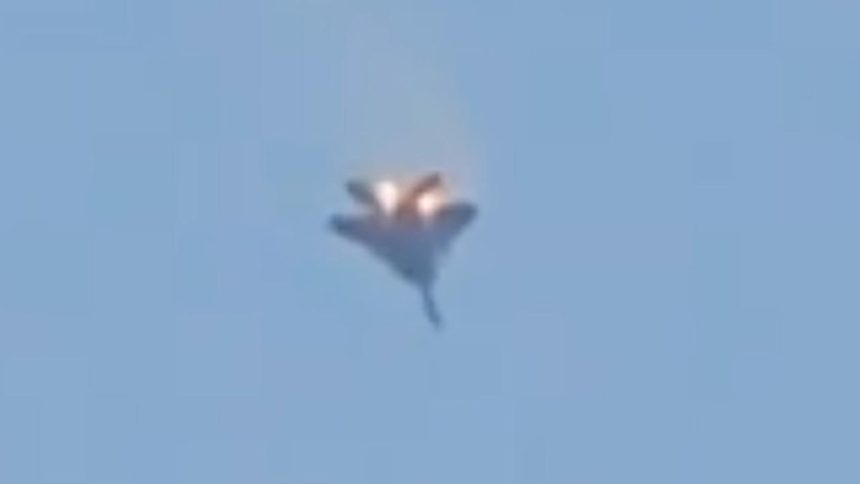
11. First F-15E Hit Mid-Flight
The first F-15E was hit mid-flight by a SAM, striking the rear fuselage and igniting fuel lines. The pilot initiated evasive turns, but damage led to loss of control, forcing ejection.
12. Second Jet Lost During Maneuver
As the second jet maneuvered to avoid debris, another missile locked on, impacting during a high-G turn and causing structural failure.
13. Third Aircraft Down Amid Confusion
Amid the confusion, the third aircraft was engaged, with radio jams exacerbating the situation, leading to its downing.
Three U.S. F-15E Strike Eagles Shot Down In Apparent Friendly Fire Incident in Kuwait – The Aviationist
14. Explosion and Fire Seen in Air
Explosions and fires were visible as fuel and munitions detonated, captured in videos showing bright fireballs against the sky.
15. Pilot Emergency Ejection Sequence
Ejections involved Martin-Baker seats propelling crews clear, with parachutes deploying automatically. Survival kits aided post-landing evasion.
16. Search and Rescue Operations Launched
CSAR teams, using helicopters like HH-60 Pave Hawks, launched immediately, recovering all in under an hour with Kuwaiti assistance.
Who Shot Down the Jets?
Attribution points to Kuwaiti forces in a friendly fire mishap, but deeper probes examine the ‘who’ behind the three F-15E Strike Eagles down over Kuwait.
17. Air Defense Forces Involved
Kuwaiti air defense units, equipped with U.S.-supplied systems, were directly involved, under high alert from Iranian threats.
18. Misidentification During Combat Situation
Misidentification stemmed from similar signatures to Iranian aircraft, compounded by combat stress.
19. Electronic Warfare and Radar Confusion
Iranian EW may have jammed signals, causing radar confusion and false locks.
20. Investigation Into Defense Coordination
Joint U.S.-Kuwaiti investigations are underway, focusing on comms and IFF failures.
Battlefield Conditions
Battlefield conditions were intense, setting the backdrop for the error that led to the jets being shot down over Kuwait.
21. Heavy Missile and Drone Activity
Iranian salvos saturated the airspace, overwhelming sensors.
22. Multi-Nation Military Presence
U.S., Kuwaiti, and other allies created a crowded operational area.
23. High Alert Status Across Gulf Region
The Gulf was on high alert due to escalating Iranian actions.
24. Communication Breakdown Risks
Comms breakdowns from jamming increased misfire risks.
Strategic & Military Impact
The strategic impact of losing three F-15E Strike Eagles down over Kuwait reverberates through U.S. military planning.
25. Loss of Advanced Strike Aircraft
Each jet costs about $80 million; the loss affects readiness.
| Aspect | Impact |
|---|---|
| Financial | $240+ million |
| Operational | Reduced strike capacity |
26. Operational Setback Analysis
Missions were paused, affecting morale and tempo.
27. Changes in Air Mission Planning
New ROE emphasize better deconfliction.
28. Increased Protection for Future Flights
Enhanced ECM and escorts are now standard.
Expert Analysis
Experts weigh in on why this happened and lessons from the three F-15E down over Kuwait.
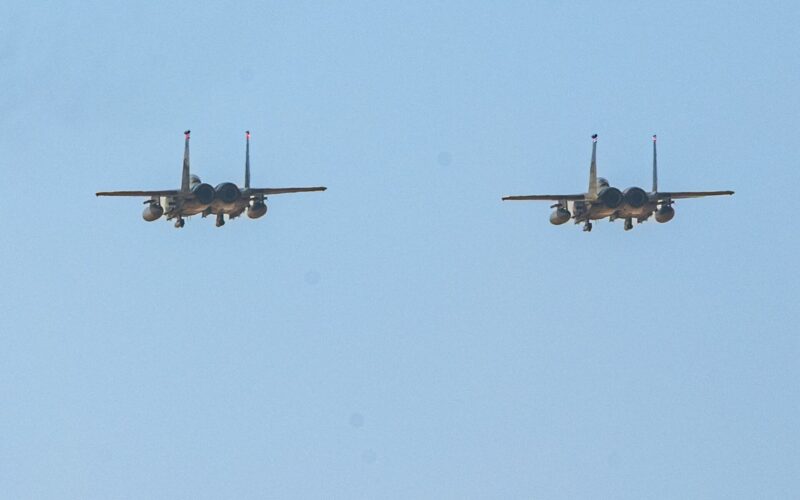
CENTCOM: Three USAF F-15Es downed by friendly fire in Kuwait
29. Why Modern Jets Still Face Risks
Despite tech, human error and EW persist as threats.
30. Importance of Identification Systems
Upgraded IFF is crucial to avoid repeats.
31. Lessons Learned From the Incident
Key lessons include improved training and tech integration.
32. Future Air Defense Coordination Needed
Multinational exercises are recommended for better harmony.
Conclusion
In recap, the three F-15E Strike Eagles down over Kuwait: how the jets were shot down and what really happened boils down to a friendly fire tragedy amid chaos. For the USA, it prompts reflection on alliances and readiness. Stay informed on updates, and support our troops as we learn from this to prevent future losses.